Introduction
Artificial intelligence has rapidly become one of the most important technologies shaping the future of national security, scientific research, and economic competitiveness. Governments around the world are investing billions of dollars in AI infrastructure to gain strategic advantages, while technology companies are racing to build the world's most powerful computing systems.
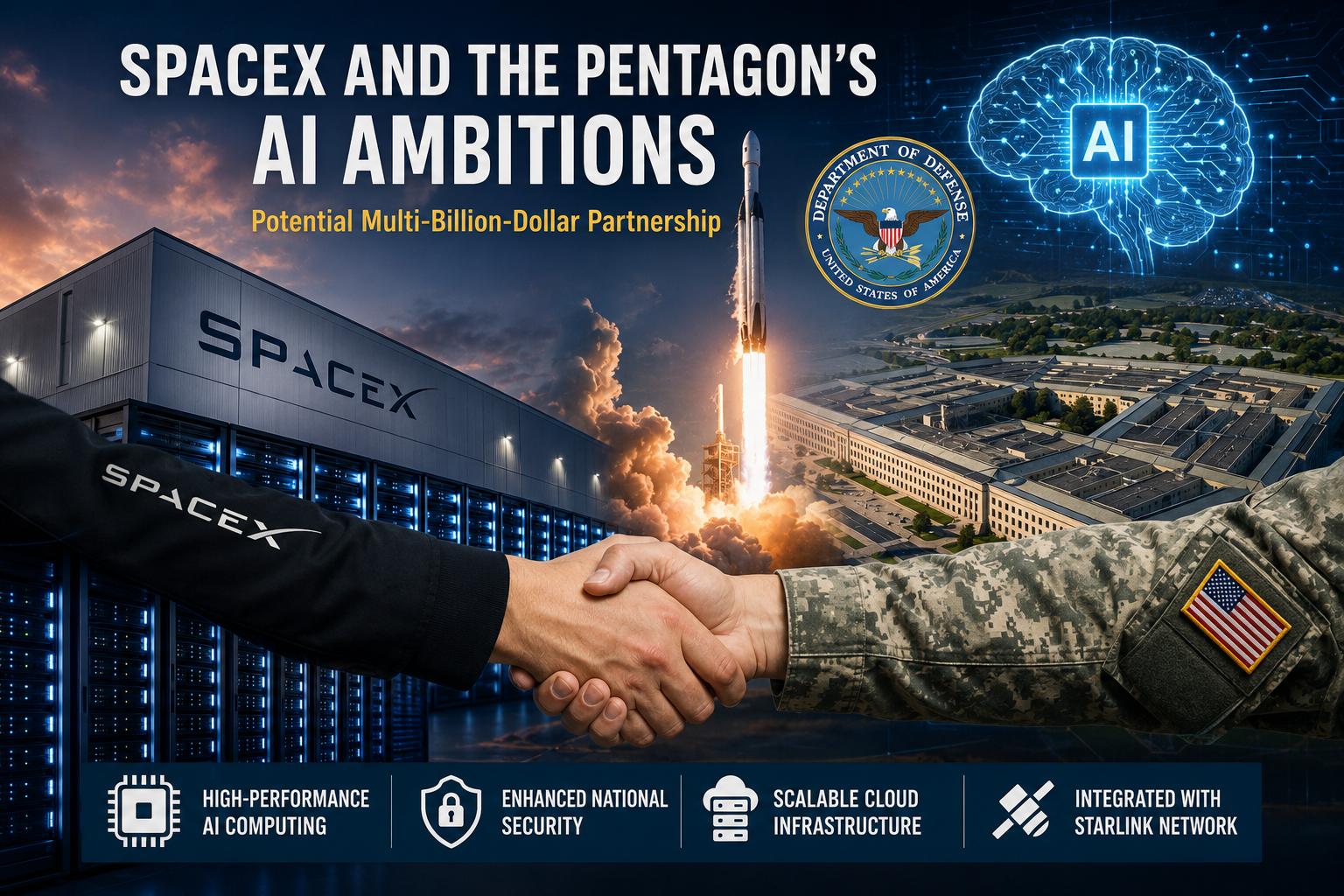
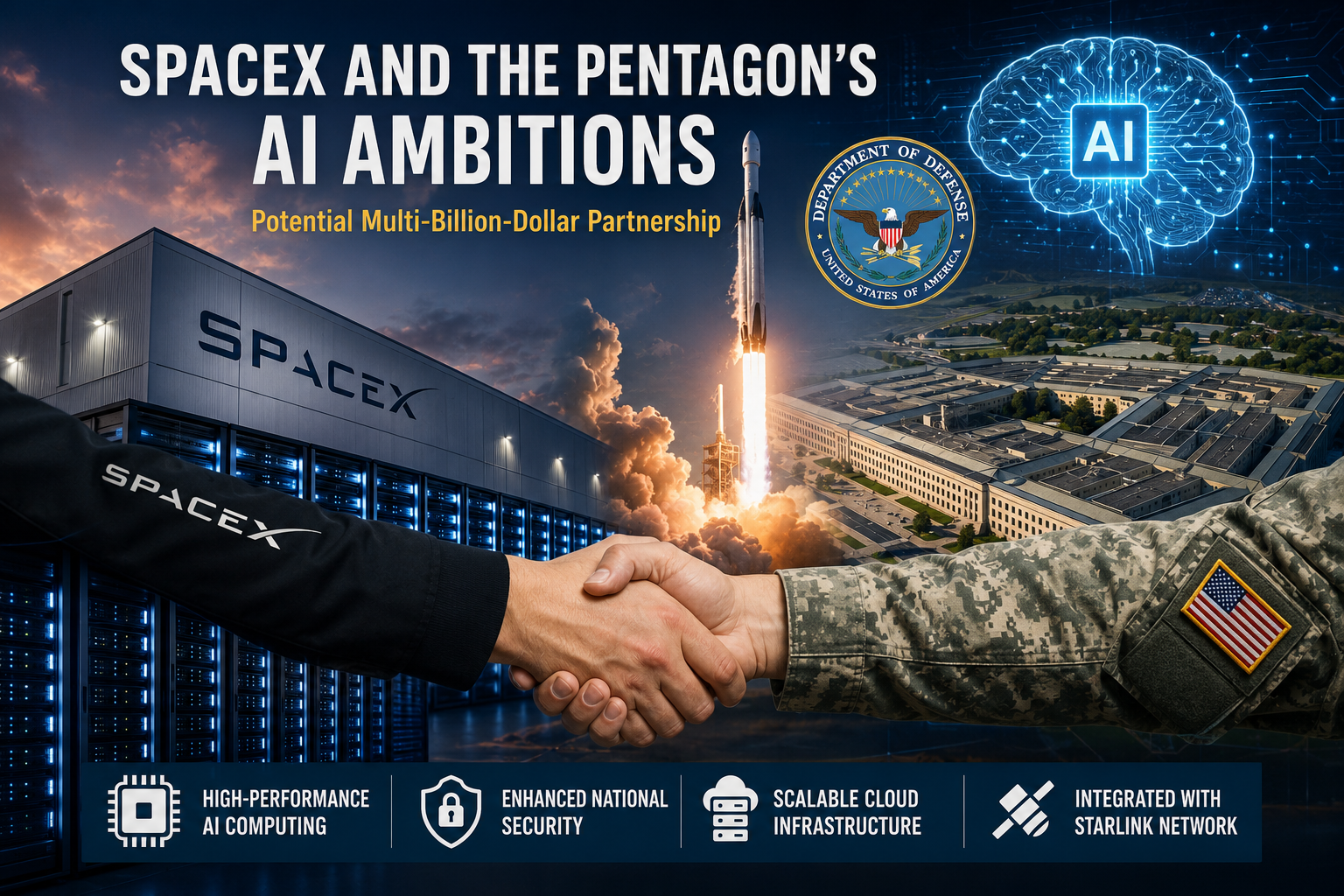
One of the most significant developments in this rapidly evolving landscape emerged this week, when reports revealed that SpaceX is in discussions with the United States Department of Defense (DoD) about providing large-scale computing infrastructure for military artificial intelligence projects. Although the negotiations are still ongoing and no final agreement has been signed, the proposed partnership could be worth several billion dollars and would represent a major expansion of SpaceX's role in both the AI industry and U.S. national defense.
The Pentagon's Growing Demand for AI
Artificial intelligence is transforming modern warfare.
Unlike previous generations of military technology that relied mainly on human decision-making, today's defense systems increasingly depend on AI to process enormous amounts of information in real time. Military AI can analyze satellite imagery, identify potential threats, monitor cyberattacks, support logistics, improve battlefield communications, and assist commanders in making faster decisions.
However, advanced AI models require enormous computing power. Training and operating these systems involves thousands of high-performance graphics processing units (GPUs), massive data centers, and tremendous amounts of electricity.
Because of these requirements, the Pentagon has been expanding its investment in AI infrastructure while seeking partnerships with major technology companies capable of delivering reliable computing resources. According to recent reports, the Department of Defense wants to diversify its suppliers instead of relying on a single cloud provider, creating opportunities for companies with large-scale AI infrastructure.
Why SpaceX?
Most people know SpaceX as the company that revolutionized spaceflight through reusable rockets and the Starlink satellite network. Founded by Elon Musk in 2002, the company has become one of the world's leading aerospace organizations, launching satellites, astronauts, and scientific missions on behalf of NASA, commercial customers, and the U.S. government.
In recent years, however, SpaceX has expanded beyond rockets.
The company has invested heavily in large AI computing facilities and cloud infrastructure. Reports indicate that it has already entered agreements with technology companies requiring enormous computing capacity for AI development. This experience has positioned SpaceX as a potential provider of AI infrastructure rather than only a space transportation company.
What Could the Deal Include?
According to reports from people familiar with the discussions, SpaceX would provide the Pentagon with access to large-scale data center capacity capable of running advanced artificial intelligence models.
Instead of purchasing expensive hardware directly, the Defense Department could rent computing capacity from SpaceX whenever needed.
Such an arrangement would offer several advantages:
Faster deployment of AI systems.
Lower infrastructure costs.
Flexible computing resources.
Improved cybersecurity.
Reduced dependence on a single technology provider.
Although negotiations remain at an early stage, industry analysts estimate that the potential agreement could be valued in the billions of dollars if finalized.
A New Business Strategy for SpaceX
The possible Pentagon partnership reflects a broader strategic shift within SpaceX.
Traditionally, the company's revenue came from rocket launches, satellite deployment, and Starlink internet services. Today, artificial intelligence infrastructure is becoming another major business opportunity.
Building AI data centers requires significant investments in specialized chips, cooling systems, networking equipment, and electricity. Once operational, however, these facilities can generate recurring revenue by leasing computing capacity to governments and private companies.
Industry observers believe AI infrastructure may become one of the fastest-growing technology markets during the next decade, driven by increasing demand for large language models, scientific computing, autonomous systems, and defense applications.
Competition in the AI Infrastructure Market
If the agreement proceeds, SpaceX would compete directly with some of the world's largest technology companies.
Major cloud providers such as Amazon Web Services (AWS), Microsoft Azure, and Google Cloud already supply computing infrastructure to government agencies and enterprise customers. New AI-focused infrastructure providers have also emerged to meet the explosive demand for GPU clusters.
SpaceX's competitive advantage could come from its ability to combine multiple technologies within one ecosystem. Beyond computing power, the company already operates Starlink's global satellite network, develops advanced aerospace systems, and maintains extensive experience working with national security agencies.
This integrated approach could allow SpaceX to provide secure, high-performance AI services tailored specifically for defense missions.
National Security Implications
Military experts increasingly argue that artificial intelligence will become as strategically important as nuclear technology or cybersecurity.
Future conflicts may depend not only on advanced weapons but also on which nation can process information the fastest.
AI could help military forces:
Detect missile launches in real time.
Analyze satellite imagery automatically.
Coordinate autonomous drones.
Predict equipment failures before they occur.
Improve intelligence gathering.
Strengthen cyber defense systems.
As these capabilities become more sophisticated, secure computing infrastructure becomes a critical component of national defense.
Ethical Questions
Despite its potential benefits, the proposed partnership also raises important ethical concerns.
Many researchers worry about the growing role of artificial intelligence in military operations.
Critics ask several important questions:
How much decision-making should be delegated to AI?
Should autonomous weapons be allowed to select targets?
How can governments ensure transparency and accountability?
Who is responsible if an AI system makes a mistake?
International organizations continue debating rules governing military AI, while technology companies face increasing pressure to balance innovation with ethical responsibility.
Financial Impact
News of the reported negotiations attracted considerable attention from investors because it highlights the growing commercial value of AI infrastructure.
Large government contracts typically provide long-term, stable revenue streams.
If the agreement is finalized, it could strengthen SpaceX's position as both an aerospace leader and a major AI infrastructure provider.
Analysts also note that defense partnerships often encourage further commercial adoption, as technologies developed for government customers frequently find applications in healthcare, manufacturing, finance, and scientific research.
Looking Ahead
Although no agreement has been officially announced, the discussions illustrate how rapidly artificial intelligence is reshaping the relationship between governments and technology companies.
The Pentagon's increasing investment in AI reflects a broader global trend in which computing power is becoming a strategic national resource.
For SpaceX, the potential partnership represents more than a new business opportunity. It signals the company's transformation from a launch provider into a diversified technology company operating across aerospace, satellite communications, cloud computing, and artificial intelligence.
Whether or not the negotiations result in a final contract, they demonstrate that future technological competition will depend not only on rockets or satellites but also on who controls the world's most advanced AI infrastructure.
Conclusion
The reported talks between SpaceX and the U.S. Department of Defense highlight a new era in which artificial intelligence, cloud computing, and national security are becoming deeply interconnected. As governments invest heavily in next-generation military technologies, companies capable of delivering massive computing resources are likely to play an increasingly important role.
While the outcome of the negotiations remains uncertain, one thing is clear: AI infrastructure is rapidly becoming as strategically valuable as traditional military hardware. The companies that build and operate these systems may shape not only the future of technology but also the balance of global power in the decades ahead.